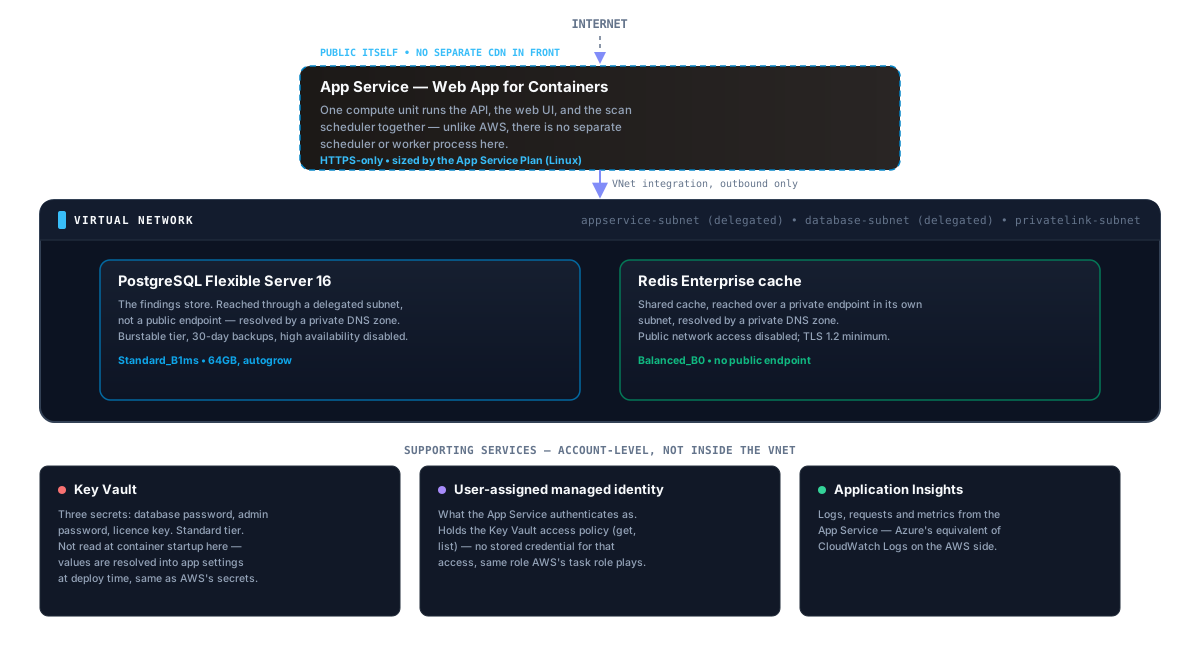
This is the actual shape of the Azure Resource Manager template — one App Service running everything, a PostgreSQL Flexible Server and a Redis Enterprise cache reached privately, and a Key Vault for the credentials it starts with.
It's a leaner shape than the AWS template, and deliberately not padded out to look symmetric: one App Service plays the role AWS splits across three ECS services, and there's no CDN layer or template-hosting bucket in front of it. Both differences are called out below rather than glossed over.
Compute
- App Service — Web App for Containers — one compute unit running the API, the web UI, and the scan scheduler together. It's the public HTTPS endpoint itself; there's no separate edge or CDN tier in front of it. HTTPS-only, sized by its App Service Plan.
- No separate scheduler or worker process. This is a real difference from the AWS deployment's three-way split into backend, scheduler and worker services — on Azure, one process does all three jobs.
Network
- Virtual network, three subnets — an app-service subnet delegated for regional VNet integration, a database subnet delegated to the Postgres server, and a subnet for the Redis private endpoint.
- VNet integration (outbound only) — how the App Service reaches the database and cache privately. It's regional integration, not hosting: the App Service's compute itself still runs outside the virtual network.
- Private DNS zones — resolve the database and cache to their private addresses inside the virtual network, linked to it directly.
Data
- PostgreSQL Flexible Server 16 — the findings store. Reached through a delegated subnet, not a public endpoint. Burstable tier, 30-day backups, high availability disabled.
- Redis Enterprise cache — shared cache, reached over a private endpoint. Public network access disabled, TLS 1.2 minimum.
Secrets & identity
- Key Vault — three secrets: the database password, the initial administrator's password, and the licence key. Standard tier.
- User-assigned managed identity — what the App Service authenticates as; holds the Key Vault access policy (get, list secrets and keys). No stored credential for that access, the same role AWS's task role plays.
Monitoring
- Application Insights — logs, requests and metrics from the App Service. Azure's equivalent of CloudWatch Logs on the AWS side.
What isn't here
- No customer-managed encryption key. Postgres and Redis encrypt at rest with Microsoft-managed keys by default; there's no Key Vault key or disk encryption set in this template, unlike AWS's KMS key.
- No storage account for collector templates. The AWS template hosts its collector setup templates in an S3 bucket the backend links to; this template has no Azure Blob Storage equivalent.
This is the hub's own account. Adding another Azure subscription, or AWS or Google Cloud, deploys a much smaller collector into it instead — covered by the permission model and the scan cycle pages.
Need this against your own security review checklist? Email support@cloud-vex.com.
Join the waitlist