Scan Cycle

The nine steps of a scan, and the exact API each one calls.

A scan is nine steps, and all nine are reads. The diagram names the exact API called in each cloud at each step, so the access you grant can be checked against it line by line rather than taken on trust.
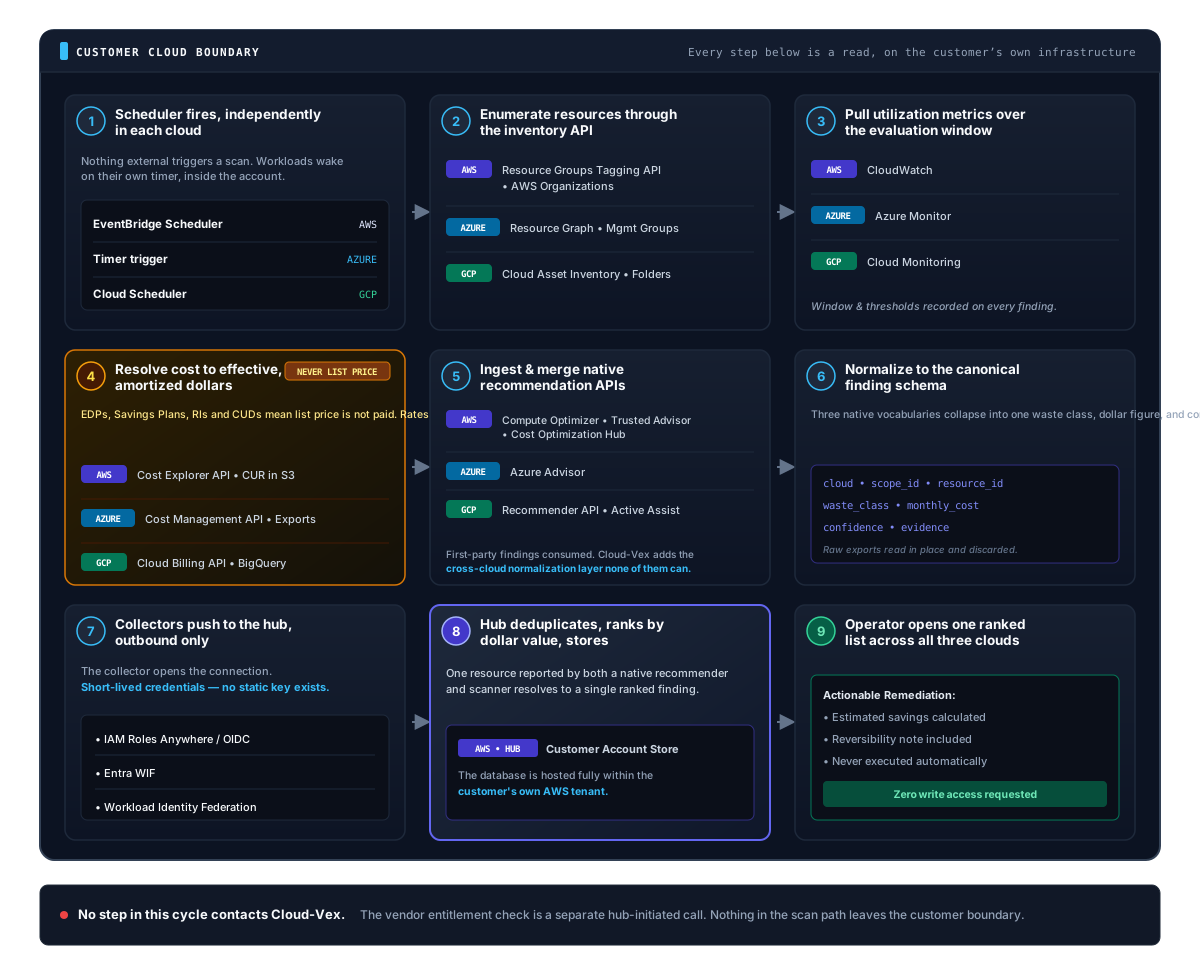
The Cloud-Vex scan cycle, nine steps, every one of them a read inside the customer's own cloud boundary. One: a scheduler fires independently in each cloud - EventBridge Scheduler on AWS, timer trigger on Azure, Cloud Scheduler on Google Cloud - so nothing external triggers a scan. Two: resources are enumerated through each inventory API - the Resource Groups Tagging API and AWS Organizations, Azure Resource Graph and management groups, Cloud Asset Inventory and folders. Three: utilization metrics are pulled over an evaluation window from CloudWatch, Azure Monitor and Cloud Monitoring, with the window and thresholds recorded on every finding. Four: cost is resolved to effective amortized dollars rather than list price, through the Cost Explorer API and Cost and Usage Report, the Azure Cost Management API and exports, and the Cloud Billing API and BigQuery, because enterprise discounts, savings plans, reserved instances and committed use discounts mean list price is not what is paid. Five: native recommendation APIs are ingested and merged - Compute Optimizer, Trusted Advisor and Cost Optimization Hub, Azure Advisor, and the Recommender API and Active Assist. Six: the three native vocabularies are normalized into one canonical finding schema of cloud, scope, resource, waste class, monthly cost, confidence and evidence, with raw exports read in place and discarded. Seven: collectors push to the hub outbound only, using short-lived credentials from IAM Roles Anywhere or OIDC, Entra workload identity federation, or Google Workload Identity Federation, so no static key exists. Eight: the hub deduplicates and ranks findings by dollar value and stores them in a database hosted entirely within the customer's own account. Nine: an operator opens one ranked list across all three clouds, each item carrying estimated savings and a reversibility note, and never executed automatically. Zero write access is requested, and no step in this cycle contacts Cloud-Vex.

Read-only, and provable. No step in the cycle writes. Cloud-Vex asks for zero write access, which is why nothing it finds is ever remediated automatically — every recommendation carries an estimated saving and a reversibility note, and you act on it.

Nothing external starts a scan. The scheduler lives in your account and fires on its own timer, in each cloud independently. There is no inbound trigger to expose.

No static keys. Collectors open the connection outbound and authenticate with short-lived credentials — IAM Roles Anywhere or OIDC, Entra workload identity federation, Google Workload Identity Federation. There is no long-lived secret to leak or rotate.

Effective cost, not list price. Enterprise discounts, savings plans, reserved instances and committed use discounts all mean list price isn't what you pay, so the billing APIs are read and the real rates amortized across their terms.

The scan path never leaves your boundary. All nine steps run on your own infrastructure. The vendor entitlement check is a separate call the hub makes on its own — see the architecture diagram for where it sits, and the compliance page for the full list of permissions requested.

Need this reviewed against your own security policy? Email support@cloud-vex.com.

Join the waitlist